


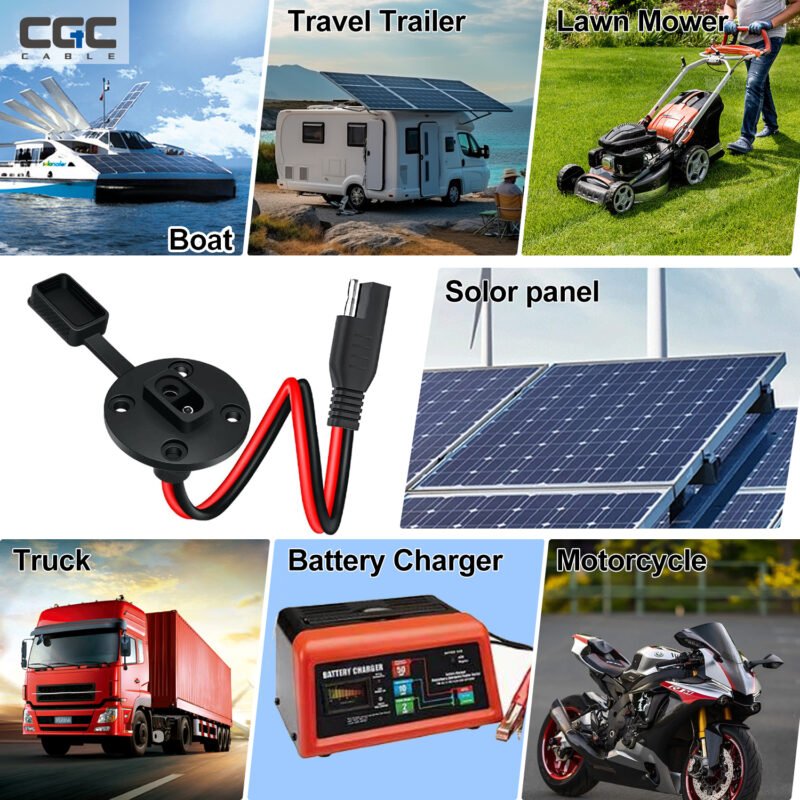
| A dangling SAE cable is functional but ugly. A flush-mount sidewall port turns it into a built-in feature. 🔌 What a sidewall port does: It is an SAE connector designed to mount through a panel — a vehicle sidewall, a camper interior, or a project box — with a dust cap protecting it when not in use. The cable runs behind the panel to your battery or power source, and the port gives you a clean plug-in point on the surface. 🚐 Where it shines: RVs, ATVs, motorcycles, and solar setups where you want a permanent, weather-resistant connection for a battery tender or accessory. Instead of fishing a cable out every time, you just pop the cap and plug in. ⚠️ The SAE polarity rule: The covered (female) end should always be the power source side, to prevent exposed pins from shorting against metal. On a flush-mount port, verify which side is hot before connecting anything — polarity mistakes on a permanent mount are harder to undo. 🔍 What to check: Dust-cap seal quality (weather protection), the gauge of the lead wire (12AWG here handles typical tender and low-draw accessory loads), and whether the mounting flange seals against the panel. 🛒 A flush-mount port is a permanent install — do it once, right. 🔗 CGCCable stocks a 12AWG flush-mount SAE sidewall port with dust cap for RVs, ATVs, and motorcycles. 👉 BUY NOW:https://cgccable.com/product/sae-quick-connect-harness-32325 #CGCCable #SAEconnector #12Vwiring #motorcycle #batterytender #solarpanel |
Related posts

Transparent Speaker Wire: Why You Can See Through Good Cable
Speaker wire with a clear jacket looks different for a reason — and it is not just for show.🔍 Why transparent: A clear jacket lets you ...

Short SAE Sidewall Port (30cm): A Compact Flush-Mount 12V Point
Sometimes you need a flush-mount SAE port, but the standard long-lead version is overkill. A 30cm short-lead port fits tight spaces.🔌 W...

SAE Extension Cable: Extending a 12V Connection the Right Way
An SAE extension is the simplest SAE product — a male on one end, a female on the other — and also the one where polarity mistakes happ...

SAE Y-Splitter 2-to-1: Combining or Splitting 12V Accessories
Two SAE devices, one battery lead — or one device fed from two sources. A 2-to-1 splitter covers both, with the same caveat as any spli...

SAE Polarity Reverse Adapter: Understanding the SAE Polarity Trap
SAE connectors have a polarity trap that catches even experienced installers. Here is how it works and how to avoid it.⚠️ The trap: SAE...

Fused SAE Cable with O-Ring: The Right Way to Connect to a Battery
Connecting an SAE accessory directly to a battery without a fuse is asking for trouble. A fused cable is the correct approach.🔋 What th...

SAE Y-Splitter 1-to-2: Powering Two Devices from One SAE Source
One SAE power source, two devices to feed. A 1-to-2 Y-splitter is the answer — with one important caveat.🔌 What the splitter does: It t...

Flush-Mount SAE Sidewall Port: A Clean 12V Connection Point
A dangling SAE cable is functional but ugly. A flush-mount sidewall port turns it into a built-in feature.🔌 What a sidewall port does: ...

Solar Cable to O-Ring Connector: The Direct-to-Battery Link Explained
Most solar cables end in MC4 connectors for panels. But the other end often needs a very different termination: an O-ring.🔌 What an O-r...

Solar Extension Cable 10AWG: Why PV Cable Is Different from Regular Wire
Not all cable survives on a roof. Solar installations need photovoltaic (PV) wire — engineered for conditions that kill standard cable ...

4-to-1 Solar Branch Connectors: Wiring Four Panels Together
Four-panel arrays push the limits of simple series wiring — a 4-to-1 branch is how DIY installers keep it clean.🔀 The series/parallel d...

3-to-1 Solar Branch Connectors: Expanding a Three-Panel Parallel Array
When two panels are not enough, the wiring gets more interesting. A 3-to-1 branch handles three panels feeding one point.🔀 Why three pa...