


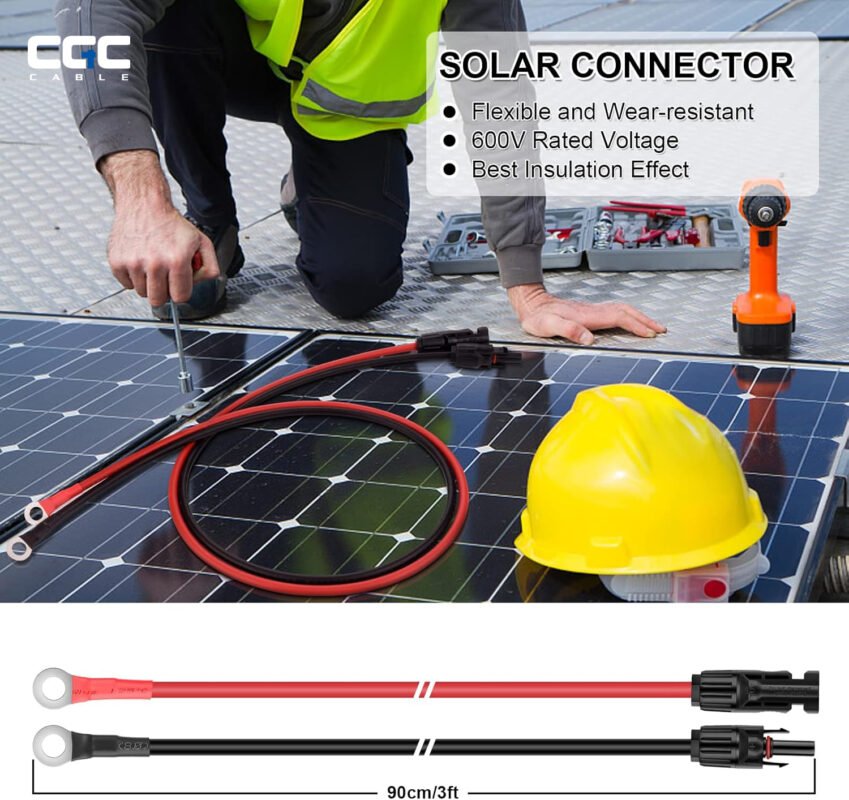
| Most solar cables end in MC4 connectors for panels. But the other end often needs a very different termination: an O-ring. 🔌 What an O-ring connector does: It is a ring terminal that bolts directly onto a battery post, charge controller terminal, or bus bar. Unlike MC4 connectors (made for panel-to-panel and panel-to-controller links), the O-ring terminates into a screw-down connection — the standard way to connect a solar system to its battery bank. ⚡ Why gauge matters here: 12AWG is a practical size for short battery-side runs. The 0.9m/3FT length keeps resistance minimal between the panel/controller and the battery, where every fraction of a volt counts in a low-voltage system. 🔍 What to check: The O-ring’s inner diameter must match your bolt size (battery terminals, bus bars, and controllers use different stud sizes). The ring should be tinned or plated to resist corrosion, and the cable insulation should be UV-rated if any of it sits outdoors. 🛒 Red and black color coding is standard and non-negotiable — reversed polarity on a battery connection damages electronics instantly. 🔗 CGCCable has a 12AWG 0.9m solar-to-O-ring cable in red and black for connecting solar systems to batteries, inverters, and generators. 👉 BUY NOW:https://cgccable.com/product/solar-cable-33339 #CGCCable #solarcable #PVwire #offgrid #DIYsolar #solarenergy |
Related posts

Transparent Speaker Wire: Why You Can See Through Good Cable
Speaker wire with a clear jacket looks different for a reason — and it is not just for show.🔍 Why transparent: A clear jacket lets you ...

Short SAE Sidewall Port (30cm): A Compact Flush-Mount 12V Point
Sometimes you need a flush-mount SAE port, but the standard long-lead version is overkill. A 30cm short-lead port fits tight spaces.🔌 W...

SAE Extension Cable: Extending a 12V Connection the Right Way
An SAE extension is the simplest SAE product — a male on one end, a female on the other — and also the one where polarity mistakes happ...

SAE Y-Splitter 2-to-1: Combining or Splitting 12V Accessories
Two SAE devices, one battery lead — or one device fed from two sources. A 2-to-1 splitter covers both, with the same caveat as any spli...

SAE Polarity Reverse Adapter: Understanding the SAE Polarity Trap
SAE connectors have a polarity trap that catches even experienced installers. Here is how it works and how to avoid it.⚠️ The trap: SAE...

Fused SAE Cable with O-Ring: The Right Way to Connect to a Battery
Connecting an SAE accessory directly to a battery without a fuse is asking for trouble. A fused cable is the correct approach.🔋 What th...

SAE Y-Splitter 1-to-2: Powering Two Devices from One SAE Source
One SAE power source, two devices to feed. A 1-to-2 Y-splitter is the answer — with one important caveat.🔌 What the splitter does: It t...

Flush-Mount SAE Sidewall Port: A Clean 12V Connection Point
A dangling SAE cable is functional but ugly. A flush-mount sidewall port turns it into a built-in feature.🔌 What a sidewall port does: ...

Solar Cable to O-Ring Connector: The Direct-to-Battery Link Explained
Most solar cables end in MC4 connectors for panels. But the other end often needs a very different termination: an O-ring.🔌 What an O-r...

Solar Extension Cable 10AWG: Why PV Cable Is Different from Regular Wire
Not all cable survives on a roof. Solar installations need photovoltaic (PV) wire — engineered for conditions that kill standard cable ...

4-to-1 Solar Branch Connectors: Wiring Four Panels Together
Four-panel arrays push the limits of simple series wiring — a 4-to-1 branch is how DIY installers keep it clean.🔀 The series/parallel d...

3-to-1 Solar Branch Connectors: Expanding a Three-Panel Parallel Array
When two panels are not enough, the wiring gets more interesting. A 3-to-1 branch handles three panels feeding one point.🔀 Why three pa...