


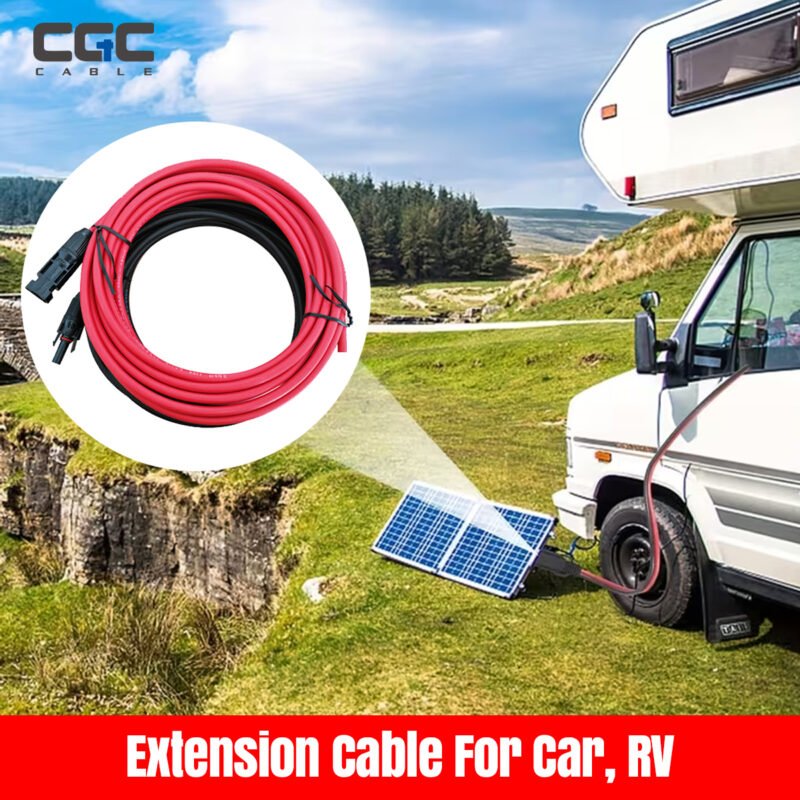
| Not all cable survives on a roof. Solar installations need photovoltaic (PV) wire — engineered for conditions that kill standard cable in 2-3 years. ☀️ What makes PV cable different: The insulation. Standard PVC turns brittle and cracks under direct UV. PV cable uses cross-linked polyethylene (XLPE) rated for 25+ years of sunlight. Use indoor wire outdoors and you will be replacing it within a few seasons. 🌡️ Temperature is the second factor. A roof or attic hits 70C in summer — beyond the continuous rating of standard THHN building wire. PV cable handles -40C to 90C without degrading. ⚡ Why gauge matters: 10AWG (6mm²) is thick enough to keep voltage drop low over distance. In a low-voltage DC system, even small losses are a meaningful percentage of efficiency — 1 volt lost at 12V is over 8% of your power gone. 🔍 Buying guide: Match gauge to your system’s current and run length — longer runs need thicker wire. This 3m/10FT extension with MC4-compatible connectors bridges the gap between panel and charge controller. 🛒 This is one component where cutting corners costs you efficiency every day for the life of the system. 🔗 CGCCable has a 3m 10AWG solar extension cable with MC4-compatible connectors (red + black) for panel-to-controller runs. 👉 BUY NOW:https://cgccable.com/product/solar-cable-33341 #CGCCable #solarcable #PVwire #offgrid #DIYsolar #solarenergy |
Related posts

Transparent Speaker Wire: Why You Can See Through Good Cable
Speaker wire with a clear jacket looks different for a reason — and it is not just for show.🔍 Why transparent: A clear jacket lets you ...

Short SAE Sidewall Port (30cm): A Compact Flush-Mount 12V Point
Sometimes you need a flush-mount SAE port, but the standard long-lead version is overkill. A 30cm short-lead port fits tight spaces.🔌 W...

SAE Extension Cable: Extending a 12V Connection the Right Way
An SAE extension is the simplest SAE product — a male on one end, a female on the other — and also the one where polarity mistakes happ...

SAE Y-Splitter 2-to-1: Combining or Splitting 12V Accessories
Two SAE devices, one battery lead — or one device fed from two sources. A 2-to-1 splitter covers both, with the same caveat as any spli...

SAE Polarity Reverse Adapter: Understanding the SAE Polarity Trap
SAE connectors have a polarity trap that catches even experienced installers. Here is how it works and how to avoid it.⚠️ The trap: SAE...

Fused SAE Cable with O-Ring: The Right Way to Connect to a Battery
Connecting an SAE accessory directly to a battery without a fuse is asking for trouble. A fused cable is the correct approach.🔋 What th...

SAE Y-Splitter 1-to-2: Powering Two Devices from One SAE Source
One SAE power source, two devices to feed. A 1-to-2 Y-splitter is the answer — with one important caveat.🔌 What the splitter does: It t...

Flush-Mount SAE Sidewall Port: A Clean 12V Connection Point
A dangling SAE cable is functional but ugly. A flush-mount sidewall port turns it into a built-in feature.🔌 What a sidewall port does: ...

Solar Cable to O-Ring Connector: The Direct-to-Battery Link Explained
Most solar cables end in MC4 connectors for panels. But the other end often needs a very different termination: an O-ring.🔌 What an O-r...

Solar Extension Cable 10AWG: Why PV Cable Is Different from Regular Wire
Not all cable survives on a roof. Solar installations need photovoltaic (PV) wire — engineered for conditions that kill standard cable ...

4-to-1 Solar Branch Connectors: Wiring Four Panels Together
Four-panel arrays push the limits of simple series wiring — a 4-to-1 branch is how DIY installers keep it clean.🔀 The series/parallel d...

3-to-1 Solar Branch Connectors: Expanding a Three-Panel Parallel Array
When two panels are not enough, the wiring gets more interesting. A 3-to-1 branch handles three panels feeding one point.🔀 Why three pa...