


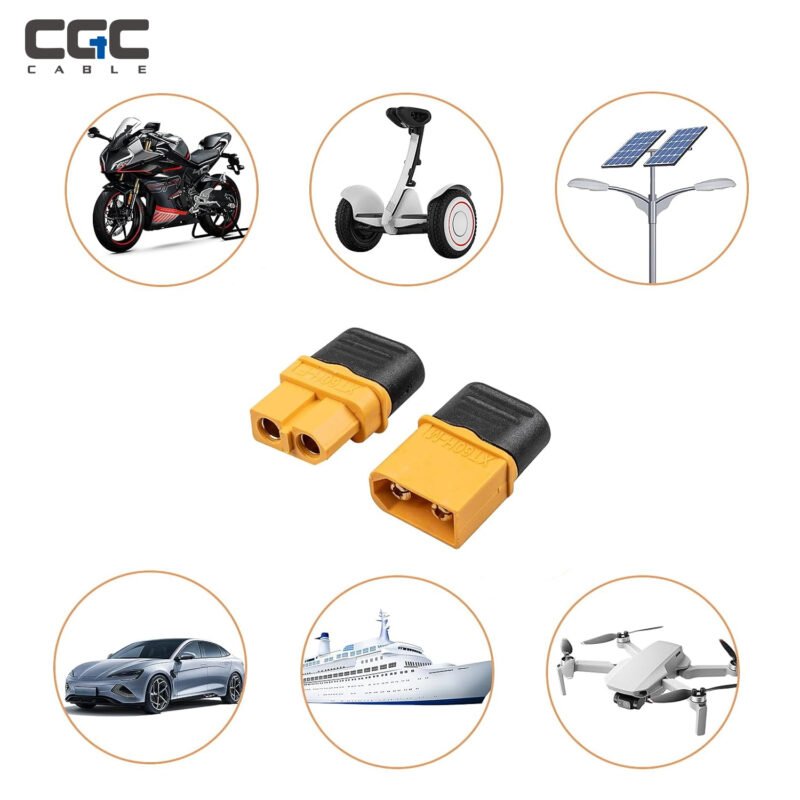
| In the RC world, connector choice affects battery compatibility, charging, and in-field reliability. The de facto standard is XT60. 🔌 Why XT60 won: The keyed nylon housing only plugs in one direction — you cannot reverse polarity by accident. Older Deans-style plugs have exposed solder tabs that can touch and short if you are not careful. XT60 recesses its gold-plated bullets inside the housing, protected from dirt, debris, and accidental contact. 🔍 The ‘H’ in XT60H: It indicates a higher-amperage variant. The standard XT60 is rated around 60A; the H version is built to handle sustained loads more comfortably with heavier contacts. For most 3S-6S LiPo builds drawing under 50A, either works; above that, the H variant gives useful thermal headroom. 🛡️ Installation rule: the male connector (exposed pins) goes on the battery side, the female (recessed sockets) on the ESC or device side. This prevents accidental shorts when handling loose batteries. Heat-shrink over the solder joints adds strain relief and insulation. 🛒 Why buy multi-pairs: Standardizing your whole fleet on one connector eliminates the adapter nightmare — no more carrying four different adapter cables to the field. 🔗 CGCCable offers 10 pairs of XT60H connectors with sheaths — enough to standardize batteries and ESCs across your RC fleet. 👉 Grab Yours Today:https://cgccable.com/product/xt60-connector-32543 #CGCCable #XT60 #RCelectronics #dronebuild #LiPo #DIYdrones #RCguide |
Related posts

14AWG Speaker Wire: When You Actually Need the Thick Stuff
14AWG is the thick end of speaker wire. You do not always need it — but when you do, nothing thinner will do.📏 What 14AWG is for: Subwo...

Single-Conductor Black Wire 18AWG: The Ground Half of Your Circuit
Every circuit needs a return path. If you bought red wire for the positive side, you need black for the ground.⚫ What single-conductor ...

Single-Conductor Red Wire 18AWG: When You Only Need One Color
Most low-voltage wire comes as a red/black pair. But sometimes you need a single color — and buying a paired cable means wasting half o...

Transparent Speaker Wire: Why You Can See Through Good Cable
Speaker wire with a clear jacket looks different for a reason — and it is not just for show.🔍 Why transparent: A clear jacket lets you ...

Short SAE Sidewall Port (30cm): A Compact Flush-Mount 12V Point
Sometimes you need a flush-mount SAE port, but the standard long-lead version is overkill. A 30cm short-lead port fits tight spaces.🔌 W...

SAE Extension Cable: Extending a 12V Connection the Right Way
An SAE extension is the simplest SAE product — a male on one end, a female on the other — and also the one where polarity mistakes happ...

SAE Y-Splitter 2-to-1: Combining or Splitting 12V Accessories
Two SAE devices, one battery lead — or one device fed from two sources. A 2-to-1 splitter covers both, with the same caveat as any spli...

SAE Polarity Reverse Adapter: Understanding the SAE Polarity Trap
SAE connectors have a polarity trap that catches even experienced installers. Here is how it works and how to avoid it.⚠️ The trap: SAE...

Fused SAE Cable with O-Ring: The Right Way to Connect to a Battery
Connecting an SAE accessory directly to a battery without a fuse is asking for trouble. A fused cable is the correct approach.🔋 What th...

SAE Y-Splitter 1-to-2: Powering Two Devices from One SAE Source
One SAE power source, two devices to feed. A 1-to-2 Y-splitter is the answer — with one important caveat.🔌 What the splitter does: It t...

Flush-Mount SAE Sidewall Port: A Clean 12V Connection Point
A dangling SAE cable is functional but ugly. A flush-mount sidewall port turns it into a built-in feature.🔌 What a sidewall port does: ...

Solar Cable to O-Ring Connector: The Direct-to-Battery Link Explained
Most solar cables end in MC4 connectors for panels. But the other end often needs a very different termination: an O-ring.🔌 What an O-r...