


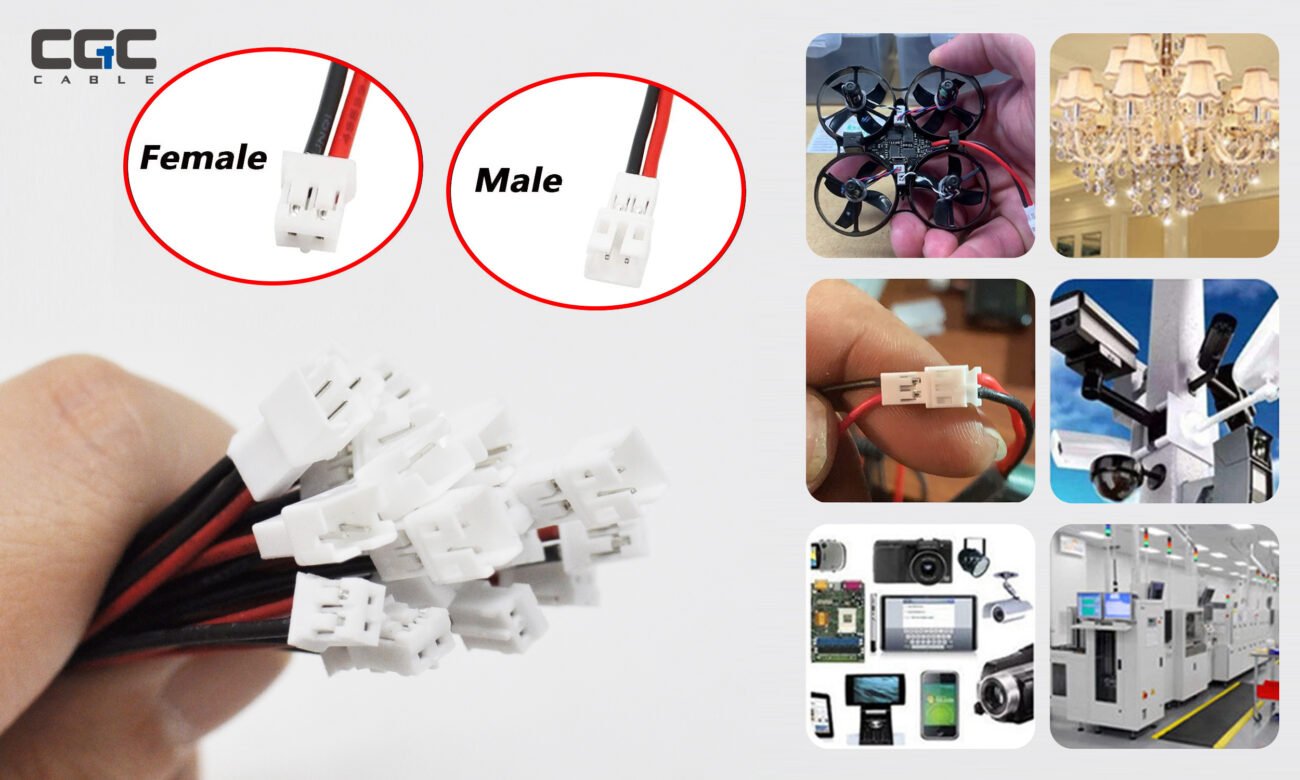
| “JST” is the most misused word in hobby electronics — it is a whole family of incompatible connectors, not one type. 🔌 The naming problem: When hobbyists say “JST connector,” they usually mean the red 2-pin plug on small LiPos — technically JST-RCY. But JST also makes XH (LiPo balance leads), PH (Spektrum receivers, 2.0mm pitch), ZH (1.5mm micro servos), and SH (1.0mm ultra-compact). None are interchangeable; plugging the wrong type can damage both connector and device. 📐 The PH2.0 series is the workhorse most people actually encounter: Arduino sensor modules, small DC motor leads, LED strip signal lines, and general logic connections under about 2 amps. Small enough for compact builds, large enough to crimp by hand. 🔍 How to identify your connector: Measure the distance between the centers of two adjacent pins — the “pitch.” 2.0mm = PH, 2.5mm = XH, 1.5mm = ZH, 1.0mm = SH. Knowing the pitch tells you exactly which family you need and stops you ordering the wrong part. 🛒 Pre-crimped kits (wires already attached and inserted into the housing) save enormous time versus hand-crimping 2.0mm pins, which needs a specialized tool and practice. 🔗 CGCCable offers 5 pairs of PH2.0 connectors with 100mm pre-crimped leads — plug-and-play for Arduino and sensor projects. 👉 Shop here: https://cgccable.com/product/jst-connector-kit-32606 #CGCCable #JSTconnector #Arduino #DIYelectronics #RCelectronics #connectors |
Related posts

Single-Conductor Red Wire 18AWG: When You Only Need One Color
Most low-voltage wire comes as a red/black pair. But sometimes you need a single color — and buying a paired cable means wasting half o...

Transparent Speaker Wire: Why You Can See Through Good Cable
Speaker wire with a clear jacket looks different for a reason — and it is not just for show.🔍 Why transparent: A clear jacket lets you ...

Short SAE Sidewall Port (30cm): A Compact Flush-Mount 12V Point
Sometimes you need a flush-mount SAE port, but the standard long-lead version is overkill. A 30cm short-lead port fits tight spaces.🔌 W...

SAE Extension Cable: Extending a 12V Connection the Right Way
An SAE extension is the simplest SAE product — a male on one end, a female on the other — and also the one where polarity mistakes happ...

SAE Y-Splitter 2-to-1: Combining or Splitting 12V Accessories
Two SAE devices, one battery lead — or one device fed from two sources. A 2-to-1 splitter covers both, with the same caveat as any spli...

SAE Polarity Reverse Adapter: Understanding the SAE Polarity Trap
SAE connectors have a polarity trap that catches even experienced installers. Here is how it works and how to avoid it.⚠️ The trap: SAE...

Fused SAE Cable with O-Ring: The Right Way to Connect to a Battery
Connecting an SAE accessory directly to a battery without a fuse is asking for trouble. A fused cable is the correct approach.🔋 What th...

SAE Y-Splitter 1-to-2: Powering Two Devices from One SAE Source
One SAE power source, two devices to feed. A 1-to-2 Y-splitter is the answer — with one important caveat.🔌 What the splitter does: It t...

Flush-Mount SAE Sidewall Port: A Clean 12V Connection Point
A dangling SAE cable is functional but ugly. A flush-mount sidewall port turns it into a built-in feature.🔌 What a sidewall port does: ...

Solar Cable to O-Ring Connector: The Direct-to-Battery Link Explained
Most solar cables end in MC4 connectors for panels. But the other end often needs a very different termination: an O-ring.🔌 What an O-r...

Solar Extension Cable 10AWG: Why PV Cable Is Different from Regular Wire
Not all cable survives on a roof. Solar installations need photovoltaic (PV) wire — engineered for conditions that kill standard cable ...

4-to-1 Solar Branch Connectors: Wiring Four Panels Together
Four-panel arrays push the limits of simple series wiring — a 4-to-1 branch is how DIY installers keep it clean.🔀 The series/parallel d...