


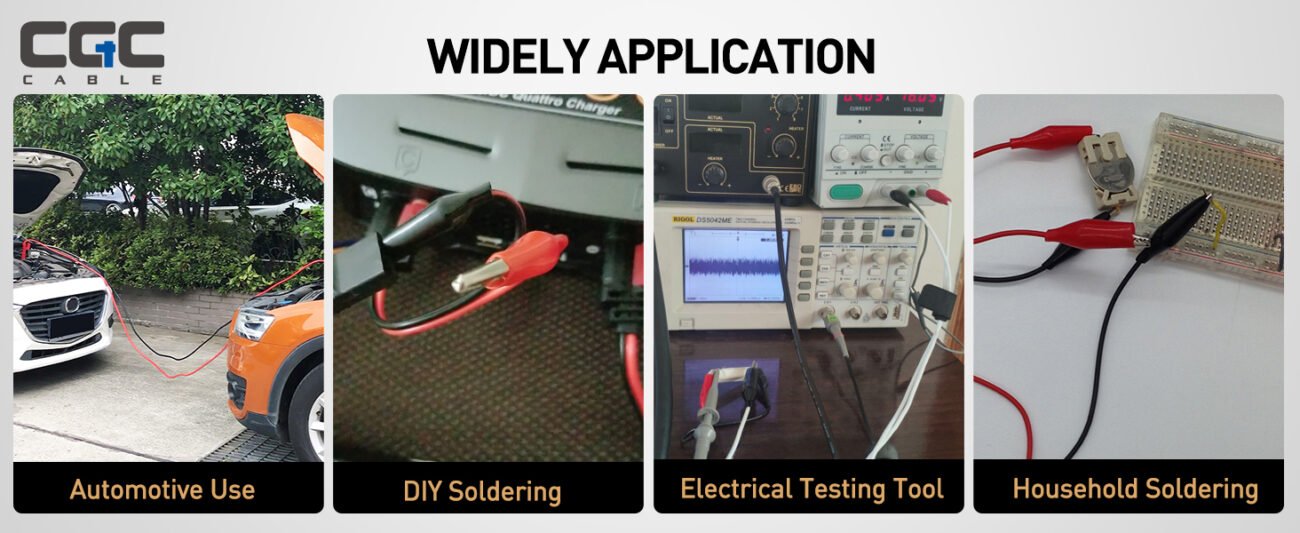
| If you work with PCBs, breadboards, or small electronics, you’ve probably struggled with standard alligator clips that are simply too big for the job. 📐 What mini alligator clips are actually for: These 27mm clips are designed for test points between 0.5mm and 3mm — the kind you find on Arduino headers, Raspberry Pi GPIO pins, small IC legs, and dense connector rows. Full-size 50mm+ clips physically can’t grip these. If you’re probing something smaller than a pencil tip, you need a mini clip. 🛡️ Why insulation matters more than you think: Red and black plastic sleeves aren’t just for polarity marking. On a crowded PCB or connector, bare metal clips sitting side-by-side can touch each other and create a short circuit — potentially damaging whatever you’re testing. Full insulation is a safety feature, not a cosmetic choice. ⚙️ These are passive components: no battery, no electronics inside. They either conduct or they don’t. If your multimeter readings start jumping around, it’s usually a worn-out clip spring losing tension — not the meter itself. Swap the clips before you blame the equipment. 🛒 What to look for when buying: Look for clips with strong spring tension (they should be noticeably firm to open), full insulation boots that cover the entire metal body, and copper or brass contacts rather than cheap steel. A multi-pack is almost always better value than singles — having spares means you’re never stuck mid-project because one clip failed. 🔗 If you’re looking for a 22pcs mini clip set with insulated sleeves, we stock one at CGCCable designed specifically for small-pitch electronics work. Tap the link to grab yours now 🔗https://cgccable.com/product/alligator-clips-electrical-31716 #CGCCable #alligatorclips #testleads #multimeter #PCBtesting #electronicsDIY #buyingguide |
Related posts

Single-Conductor Red Wire 18AWG: When You Only Need One Color
Most low-voltage wire comes as a red/black pair. But sometimes you need a single color — and buying a paired cable means wasting half o...

Transparent Speaker Wire: Why You Can See Through Good Cable
Speaker wire with a clear jacket looks different for a reason — and it is not just for show.🔍 Why transparent: A clear jacket lets you ...

Short SAE Sidewall Port (30cm): A Compact Flush-Mount 12V Point
Sometimes you need a flush-mount SAE port, but the standard long-lead version is overkill. A 30cm short-lead port fits tight spaces.🔌 W...

SAE Extension Cable: Extending a 12V Connection the Right Way
An SAE extension is the simplest SAE product — a male on one end, a female on the other — and also the one where polarity mistakes happ...

SAE Y-Splitter 2-to-1: Combining or Splitting 12V Accessories
Two SAE devices, one battery lead — or one device fed from two sources. A 2-to-1 splitter covers both, with the same caveat as any spli...

SAE Polarity Reverse Adapter: Understanding the SAE Polarity Trap
SAE connectors have a polarity trap that catches even experienced installers. Here is how it works and how to avoid it.⚠️ The trap: SAE...

Fused SAE Cable with O-Ring: The Right Way to Connect to a Battery
Connecting an SAE accessory directly to a battery without a fuse is asking for trouble. A fused cable is the correct approach.🔋 What th...

SAE Y-Splitter 1-to-2: Powering Two Devices from One SAE Source
One SAE power source, two devices to feed. A 1-to-2 Y-splitter is the answer — with one important caveat.🔌 What the splitter does: It t...

Flush-Mount SAE Sidewall Port: A Clean 12V Connection Point
A dangling SAE cable is functional but ugly. A flush-mount sidewall port turns it into a built-in feature.🔌 What a sidewall port does: ...

Solar Cable to O-Ring Connector: The Direct-to-Battery Link Explained
Most solar cables end in MC4 connectors for panels. But the other end often needs a very different termination: an O-ring.🔌 What an O-r...

Solar Extension Cable 10AWG: Why PV Cable Is Different from Regular Wire
Not all cable survives on a roof. Solar installations need photovoltaic (PV) wire — engineered for conditions that kill standard cable ...

4-to-1 Solar Branch Connectors: Wiring Four Panels Together
Four-panel arrays push the limits of simple series wiring — a 4-to-1 branch is how DIY installers keep it clean.🔀 The series/parallel d...