


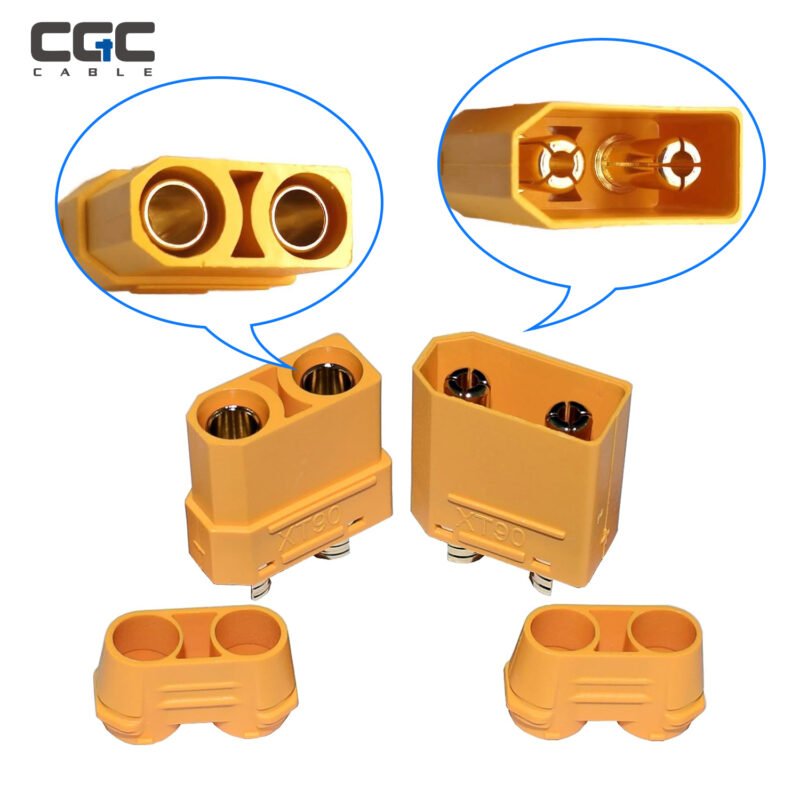
| If your build pulls serious current — large multirotors, high-power ground vehicles, electric skateboards — XT60 may be the wrong connector. ⚡ What changes with XT90: Everything is physically bigger — larger bullets, thicker housing, wider solder cups. More contact surface means less resistance, which means less heat at a given current. The 90 in the name refers to the 90A continuous rating. 🔥 What the ‘H’ in XT90H means: anti-spark. On 6S LiPo and above, connecting a battery causes a loud pop as the ESC capacitors charge instantly. XT90H adds a small resistor that pre-charges the capacitors first, then the main contacts engage. No spark, no pop, no pitted connector faces — and both your connectors and capacitors last longer. 🔍 When to step up from XT60: A conservative rule — if your system draws more than 50A continuous, go XT90. The weight and cost penalty is negligible next to the safety margin. At 6S or higher voltage, the anti-spark alone justifies the switch. 🛒 The anti-spark resistor is directional — only one side of the pair has it. Understand which end goes on the battery and which on the ESC before soldering. 🔗 CGCCable carries 6 pairs of XT90H connectors with anti-spark protection — the safer choice for high-voltage RC power systems. 👉 Grab Yours Today:https://cgccable.com/product/xt90h-connector-32556 #CGCCable #XT90 #RCelectronics #highpower #DIYdrones #antispark |
Related posts

Single-Conductor Red Wire 18AWG: When You Only Need One Color
Most low-voltage wire comes as a red/black pair. But sometimes you need a single color — and buying a paired cable means wasting half o...

Transparent Speaker Wire: Why You Can See Through Good Cable
Speaker wire with a clear jacket looks different for a reason — and it is not just for show.🔍 Why transparent: A clear jacket lets you ...

Short SAE Sidewall Port (30cm): A Compact Flush-Mount 12V Point
Sometimes you need a flush-mount SAE port, but the standard long-lead version is overkill. A 30cm short-lead port fits tight spaces.🔌 W...

SAE Extension Cable: Extending a 12V Connection the Right Way
An SAE extension is the simplest SAE product — a male on one end, a female on the other — and also the one where polarity mistakes happ...

SAE Y-Splitter 2-to-1: Combining or Splitting 12V Accessories
Two SAE devices, one battery lead — or one device fed from two sources. A 2-to-1 splitter covers both, with the same caveat as any spli...

SAE Polarity Reverse Adapter: Understanding the SAE Polarity Trap
SAE connectors have a polarity trap that catches even experienced installers. Here is how it works and how to avoid it.⚠️ The trap: SAE...

Fused SAE Cable with O-Ring: The Right Way to Connect to a Battery
Connecting an SAE accessory directly to a battery without a fuse is asking for trouble. A fused cable is the correct approach.🔋 What th...

SAE Y-Splitter 1-to-2: Powering Two Devices from One SAE Source
One SAE power source, two devices to feed. A 1-to-2 Y-splitter is the answer — with one important caveat.🔌 What the splitter does: It t...

Flush-Mount SAE Sidewall Port: A Clean 12V Connection Point
A dangling SAE cable is functional but ugly. A flush-mount sidewall port turns it into a built-in feature.🔌 What a sidewall port does: ...

Solar Cable to O-Ring Connector: The Direct-to-Battery Link Explained
Most solar cables end in MC4 connectors for panels. But the other end often needs a very different termination: an O-ring.🔌 What an O-r...

Solar Extension Cable 10AWG: Why PV Cable Is Different from Regular Wire
Not all cable survives on a roof. Solar installations need photovoltaic (PV) wire — engineered for conditions that kill standard cable ...

4-to-1 Solar Branch Connectors: Wiring Four Panels Together
Four-panel arrays push the limits of simple series wiring — a 4-to-1 branch is how DIY installers keep it clean.🔀 The series/parallel d...